
-
Welcome to the Hydraulic Fracturing and Fracture Fluid Information Site. This website is a project of the BC Oil & Gas Commission and is intended to provide objective information on Hydraulic Fracturing. Fracturing Fluids, Groundwater and Surface water protection and related oil and gas activities in Canada.
-
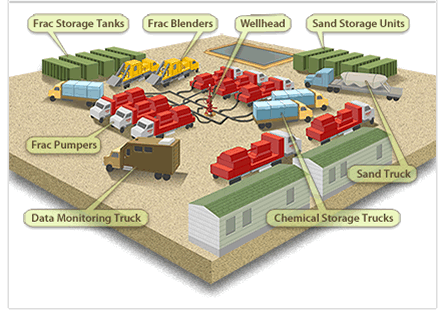
Hydraulic FracturingHow it WorksWell Site: Roads, trucks, a rig, pumping units and drilling equipment are all shuttled or stored at the drilling location.
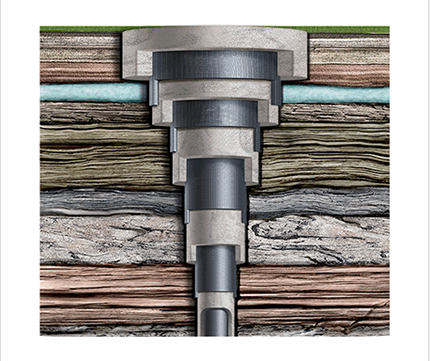
 Casing:Layers of protective steel and cement are used to ensure water acqifers reamain undisturbed.
 Hydraulic Fracturing:Mixture of water, sand and chemicals pressurized and pumped into the well to form microscopic fractures in shale.This technique uses a specially blended liquid which is pumped into a well under extreme pressure causing cracks in rock formations underground. These cracks in the rock then allow oil and natural gas to flow, increasing resource production.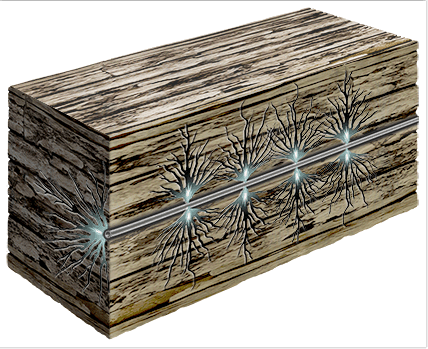
More about the process > -
Casing & CementHow it WorksMultiple Layers: Layers of cement and steel are constructed between the producing wellbore and the water acquifer. This is a cross section showing the protective redundancy.Protective Depth: The first layer of casing typically runs 30-60 feet deep. The next layer runs 500-1,500 feet deep, with the inner most layer running 5,000-10,000 feet deep - thousands of feet below usable groundwater.Casing is the multiple layers of steel and cement inside the drilled hole used to protect water aquifers. The specific length, thickness, strength and composition of casing is regulated at the state level.
Learn More About Casing > -
ChemicalUse
-
Welcome to the Hydraulic Fracturing and Fracture Fluid Information Site. This website is a project of the BC Oil & Gas Commission and is intended to provide objective information on Hydraulic Fracturing. Fracturing Fluids, Groundwater and Surface water protection and related oil and gas activities in Canada.
Groundwater Protection: Priority Number One
Oil and natural gas producers have stringent requirements for how wells must be completed. The genesis of these requirements is water safety.
Casing is the first line of defense used to protect freshwater aquifers.
More About Groundwater Protection »

 News & Updates »
 Ask a Question »
 Chemical Use »
 How It Works »
 Regulations »
FAQ's
-
How can I learn more about the Hazardous Material Information Review Act?
Hazardous Materials Information Review Commission
427 Laurier Avenue West, 7th floor
Ottawa, Ontario
K1A 1M3 CanadaWebsite: www.hmirc-ccrmd.gc.ca/ ‡
Telephone: 613-993-4331
Fax: 613-993-4686
E-mail: hmirc-ccrmd@hc-sc.gc.ca
-
I know there are wells in my area that have been fractured, but when I search for them I get no results. Why?
The most likely reasons are that either the wells were fractured before January 1, 2012 (British Columbia) or January 1, 2013 (Alberta) or they have not yet been entered into the system. Only wells fractured after those dates will be entered into the system. Furthermore, companies undertaking hydraulic fracturing operations have 30 days from the time their completion operations have finished to submit their records. Initially, records for Alberta wells may take longer than the 30 days noted as licensees develop systems to compile and report the information electronically. Please keep checking back as wells are added on a daily basis
-
Is the raw data available for fracfocus.ca?
Yes, the raw data for BC and Alberta are available directly from each regulator's website.
For BC, the database is available at https://bcogc.ca/online-services. Please navigate to the REPORTS section under Reservoir Engineering to a link called Complete FracFocus Data.
For Alberta, you can access this information through the AER Product and Services Catalogue as a self-serve item. Specifically, it is found within the ‘Wells’ category, with the product name “Hydraulic Fracturing Water Source and Water Use Data”. As the product name implies, there is detailed information on water used for hydraulic fracturing operations, as well as the source(s) of that water; fluid composition information is found within the ‘Hydraulic Fracturing Water Use Data (Annual)’ self-serve file.
-
How can I learn more about the Hazardous Material Information Review Act?
Hazardous Materials Information Review Commission
427 Laurier Avenue West, 7th floor
Ottawa, Ontario
K1A 1M3 CanadaWebsite: www.hmirc-ccrmd.gc.ca/ ‡
Telephone: 613-993-4331
Fax: 613-993-4686
E-mail: hmirc-ccrmd@hc-sc.gc.ca
-
I know there are wells in my area that have been fractured, but when I search for them I get no results. Why?
The most likely reasons are that either the wells were fractured before January 1, 2012 (British Columbia) or January 1, 2013 (Alberta) or they have not yet been entered into the system. Only wells fractured after those dates will be entered into the system. Furthermore, companies undertaking hydraulic fracturing operations have 30 days from the time their completion operations have finished to submit their records. Initially, records for Alberta wells may take longer than the 30 days noted as licensees develop systems to compile and report the information electronically. Please keep checking back as wells are added on a daily basis